Blog
Becker's Healthcare Webinar

Sheela Venkobaao details why the inclusion of Lab Performer and Result Date / Time are important accountability measures that should be added to USCDI v8 standards.

A laboratory result is more than a test code and a value. At the source, its workflow usually makes clear which laboratory or practitioner is responsible for the result and when the specimen was collected. Those facts are easy to see inside the originating laboratory information system. They are easier to lose when a result is converted to a different format, decomposed into individual records, or moved through an HIE, interface engine, or aggregation platform.
That loss is easy to overlook because the receiving system may still have the value, units, reference interval, and specimen details. But without result-level provenance, the receiver may not know which laboratory or practitioner produced the result or when the specimen was actually obtained.
This paper focuses on two fields: Lab Performer and Result Date/Time. Both describe the individual laboratory result — the same unit as every other element in USCDI's Laboratory data class. Both are already generated in the large majority of production laboratory records. What is missing is a binding exchange obligation to carry them through.
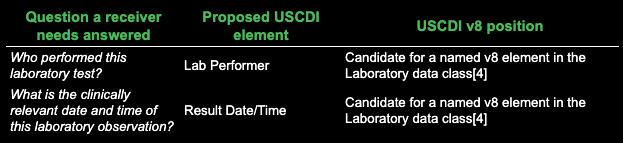
Lab Performer tells a receiving team where to route a question, correction, or amendment. Result Date/Time tells them when the result was actually obtained — which is not always the same as when the consolidated or summary report was released, or when the result appeared in their system. Exchange should preserve both.
The strongest case starts with precise role boundaries:
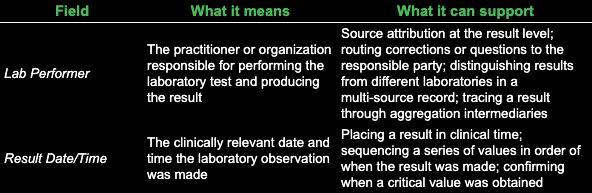
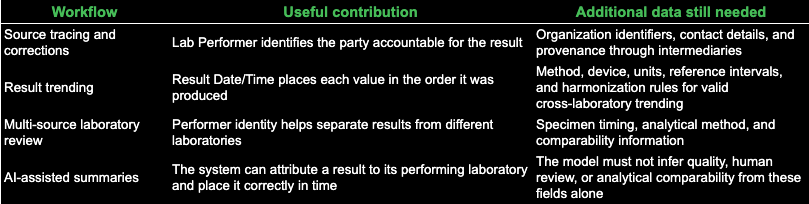
The exchange problem is not that a receiving clinician cannot practice without these fields. It is that every missing performer or timestamp reduces the interpretability and traceability of a result. A value without a performer cannot be attributed to a responsible source — making corrections harder, and multi-source reconciliation dependent on inference rather than structured data. A value without a result timestamp cannot be reliably placed in clinical time — which matters for trending chronic disease markers, confirming that an acute result predates a treatment change, or evaluating whether a critical value was obtained before or after an intervention. Structured result-level provenance makes that work faster, more auditable, and less dependent on institutional memory.
Predoc reviewed structured laboratory data across production deployments that include multiple EHR vendors, HIE feeds, reference-laboratory feeds, and payer-derived sources.[5]
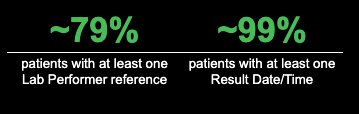
How to read these figures
Patient coverage is the percentage of patients with at least one eligible laboratory record containing the field. Record fill is the percentage of eligible individual laboratory records containing the field. The internal fields ending in practitioner_role_id are references to a role record — not a person's name. A role reference may resolve to a practitioner, an organization, or both when linked identity data is available.
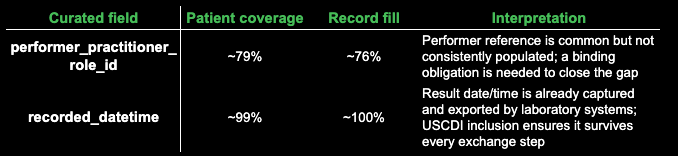
These figures answer an implementation question: both fields are already generated often enough to support standardization.[5] They do not establish clinical value on their own. The value comes from ensuring the correct performer identity and the actual result date/time are preserved when a result moves between systems.
A role reference in Predoc's data is a reference to a role record, not a person's name, and does not by itself establish that a named individual performed the test in every case.
A receiving care team may need to confirm which laboratory or practitioner is responsible for a result, request a correction, or resolve a discrepancy between results from different sources. Lab Performer gives that team a structured route back to the responsible party. It also helps an aggregation platform distinguish a result produced by one laboratory from a copy transmitted by an HIE or incorporated from another EHR.
Lab Performer should not be read as a proxy for analytical method. Knowing the responsible laboratory is a starting point for locating applicable reference intervals or method documentation — but the field identifies the accountable party, not the instrument, reagent, assay, or calibration used. Trend analysis that must account for method differences requires additional data beyond performer identity.
Trending a series of values, confirming that a critical result was obtained before a medication was started, or placing a laboratory finding relative to a clinical event all depend on knowing when the result was made — not when the consolidated report was released or when the result arrived in the receiving system. Result Date/Time is that timestamp: the clinically relevant date and time of the observation itself. Without it, the receiver is working with a value whose position in clinical time has to be reconstructed from other sources.
The following scenarios illustrate where the absence of performer identity or result timestamp produces a concrete gap in a receiving clinician's ability to interpret or act on a result.
Chronic disease management — diabetes. A care team receives an HbA1c result in a consolidated record. Without Result Date/Time, they cannot confirm whether the value reflects a draw from last week or six months ago — a distinction that directly affects medication titration decisions. Without Lab Performer, a discrepancy between two HbA1c values from different sources cannot be attributed for follow-up or reconciliation.
Acute condition workup — infectious disease. A patient presents with fever and an elevated WBC. Results from a prior urgent care visit appear in the aggregated record. Without Result Date/Time at the individual result level, the care team cannot confirm the temporal relationship between the prior results and the current presentation. Without Lab Performer, they cannot determine which laboratory performed the prior culture and whether sensitivities were reported under the same methodology.
Multi-source record review — chronic kidney disease. A nephrologist reviews a patient's eGFR trajectory across three sources: a health system EHR, an HIE feed, and a reference laboratory. Without Result Date/Time on each individual result, the trend cannot be sequenced reliably. Without Lab Performer, the nephrologist cannot determine whether apparent value shifts reflect clinical change or differences between laboratories.
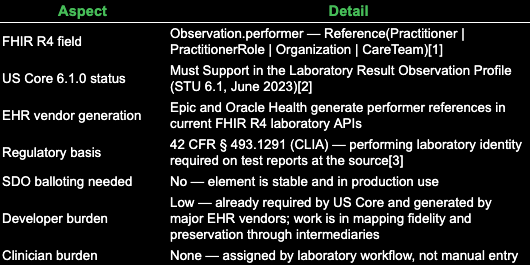
Both fields are representable using existing, normative FHIR R4 standards.[1] No new resources, profiles, or code systems are required — and both are already Must Support in US Core today.
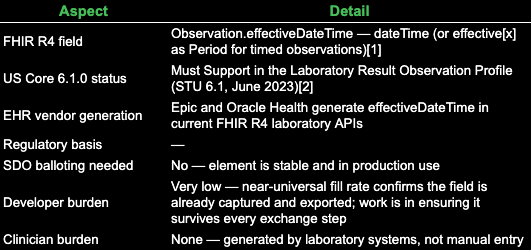
US Core Laboratory Result Observation Profile v6.1.0 — finalized June 2023 — marks both Observation.performer and Observation.effectiveDateTime as Must Support.[2] Epic and Oracle Health (Cerner Millennium) generate both fields in their FHIR R4 laboratory result APIs in current production deployments. CLIA regulations (42 CFR § 493.1291) require performing laboratory identity on test reports at the source,[3] establishing a regulatory floor that USCDI exchange can reinforce at the individual result level. No SDO balloting is needed — both elements are stable, in production use, and defined in normative FHIR R4.[1]
// FHIR R4 Observation — performer field
{ "resourceType": "Observation",
"performer": [{
"reference": "Organization/lab-123",
"display": "Regional Reference Laboratory" }]}
// FHIR R4 Observation — effectiveDateTime field
{ "resourceType": "Observation",
"effectiveDateTime": "2026-03-14T09:22:00-05:00"}
Lab Performer and Result Date/Time are already generated in the large majority of production laboratory records.[5] Both are marked Must Support in US Core.[2] Both are produced by Epic and Oracle Health in current deployments. CLIA requires performing laboratory identity on reports at the source.[3] No new technical standard is needed — the implementation work is in mapping, transformation logic, and ensuring that what exists at the source is not dropped in transit.
The path to USCDI v8 inclusion is as clear as it can be for two proposed elements. Predoc requests that ONC add Lab Performer and Result Date/Time as named Level 2 elements in the Laboratory data class — so that who performed a result and when the observation was made travel with the result, every time, across every exchange step.
Stop manually chasing and cleaning records. See how Predoc seamlessly integrates with your existing systems to deliver normalized, actionable data right when you need it.