Becker's Healthcare Webinar

Proprietary provider registry
Trained on 3+ years of transcribed calls
Trained on our human expert annotation team
Trained on our human expert annotation team
Clinician and customer-verified model
Built from years inside the workflow
Predoc has built specialized agents and data-processing systems across the medical-record workflow to reduce turnaround, expand capacity, and convert offline records into a normalized clinical intelligence foundation.

The most powerful AI workflow replacements in healthcare will not be built around the cleanest, most standardized tasks. Those tasks are the easiest to automate, and the easiest to commoditize.
The more consequential systems of agents will emerge from workflows where bespoke conversations, missing information, facility-specific rules, outlier documents, and unpredictable turns are not edge cases. They are the work.
Building a multi-agent system to automate these kinds of workflows requires deeply understanding the jobs to be done, the outliers, and creating a proprietary data set to serve as the foundation for agentic deployment.
We have a first-hand perspective on what it takes to build such a system, and how this sort of system can fundamentally change the efficiency and scalability of a burdensome administrative task. Our perspective has been shaped by building a multi-agent system that spans every modality of AI to automate some of healthcare’s grittiest, most offline administrative work: retrieving and organizing medical records. The system spans provider identification, outreach, record receipt, indexation, and normalization, returning completed work rather than another queue for the customer to manage.
Predoc’s approach is to deeply understand and document the work before attempting to automate it. We then divide the workflow into bounded jobs, require each job to produce a structured output, and preserve a human escalation path for the exceptions that cannot yet be resolved reliably. Each resolution becomes additional workflow knowledge.
That approach has produced several distinct, proprietary datasets that could only have been built through years of intentionally living in this workflow. We built our agentic foundation from the documentation stemming from millions of retrievals. The foundation was built on 300k–400k meticulously documented provider-research tasks, nearly 3 years of transcribed retrieval calls, millions of returned medical-record pages and their associated review decisions, and extraction schemas spanning approximately 16 clinical and 10 non-clinical categories.
The dataset behind each capability is different because the job is different. Together, automating each job completes a workflow: retrieving a patient’s records, organizing the return, and transforming the result into a normalized clinical intelligence foundation.
The early operating results show why the architecture matters. Against the two-week-or-longer turnaround many customers previously experienced, Predoc now delivers offline records—retrieved, indexed, and transformed into curated patient data—in a median of three business days, a 75% improvement. Provider-research time has declined by 70%, first-pass retrieval success has improved by nearly 50%, voice AI is estimated to reduce per-minute outreach costs by 75%–92%, active indexation time has fallen by nearly 50%, and 94.6% of pages containing medical-record content proceed through indexation without human intervention. A separate curation analysis found that nearly 70% of noisy, duplicative, incomplete, or semantically redundant objects could be removed from core clinical data while preserving clinically meaningful facts and traceability.
The results appear along three dimensions. Efficiency: complete histories move faster and cost less to produce. Elasticity: capacity can grow with customer demand without proportional growth in human labor. Accuracy: high-confidence work advances automatically while incomplete, unusual, or lower-confidence cases remain subject to human judgment.
The pattern becomes clearest when you follow the record.
The fastest retrieval is the one that starts correctly. Predoc has turned years of intentional, methodical retrieval history into operational intelligence that identifies not only which provider has the records, but which path is most likely to produce them.
The first retrieval decision is not simply identifying the provider. It is determining which action is most likely to produce the records. This realization came as part of capturing the workflow data. A non-trivial amount of time is spent on researching / learning the best or most successful pathway for a retrieval as the task is more difficult than identifying a provider.
Public and commercial provider directories can usually supply an address, specialty, NPI, or main phone number. They rarely contain the details that determine whether a records request succeeds: the medical-records department line, the monitored fax number, a separate stat pathway, the correct IVR sequence, or the contact who previously unblocked a stalled request.
Understanding the workflow data we needed to capture involved the recognition that historically, that knowledge lived with experienced operators. They searched provider websites, compared locations, called main lines, tested fax numbers, and recorded what worked. The strongest teams developed deep institutional memory, but much of it remained trapped in free-text notes or individual employees’ experience. The next operator often had to rediscover information the organization technically already knew.
Predoc built its research agent on a knowledge base of approximately 300,000–400,000 provider-research tasks. Each task generated evidence about which facility held the records, which phone or fax route worked, which attempts failed, what the provider required, and which action ultimately produced a return. Instead of leaving that knowledge in free-text notes or an experienced operator’s memory, Predoc structured it for reuse.
The Research Agent has a bounded job: for each request, it traverses the structured provider-intelligence layer, evaluates the available routes, and selects the highest-confidence next action.
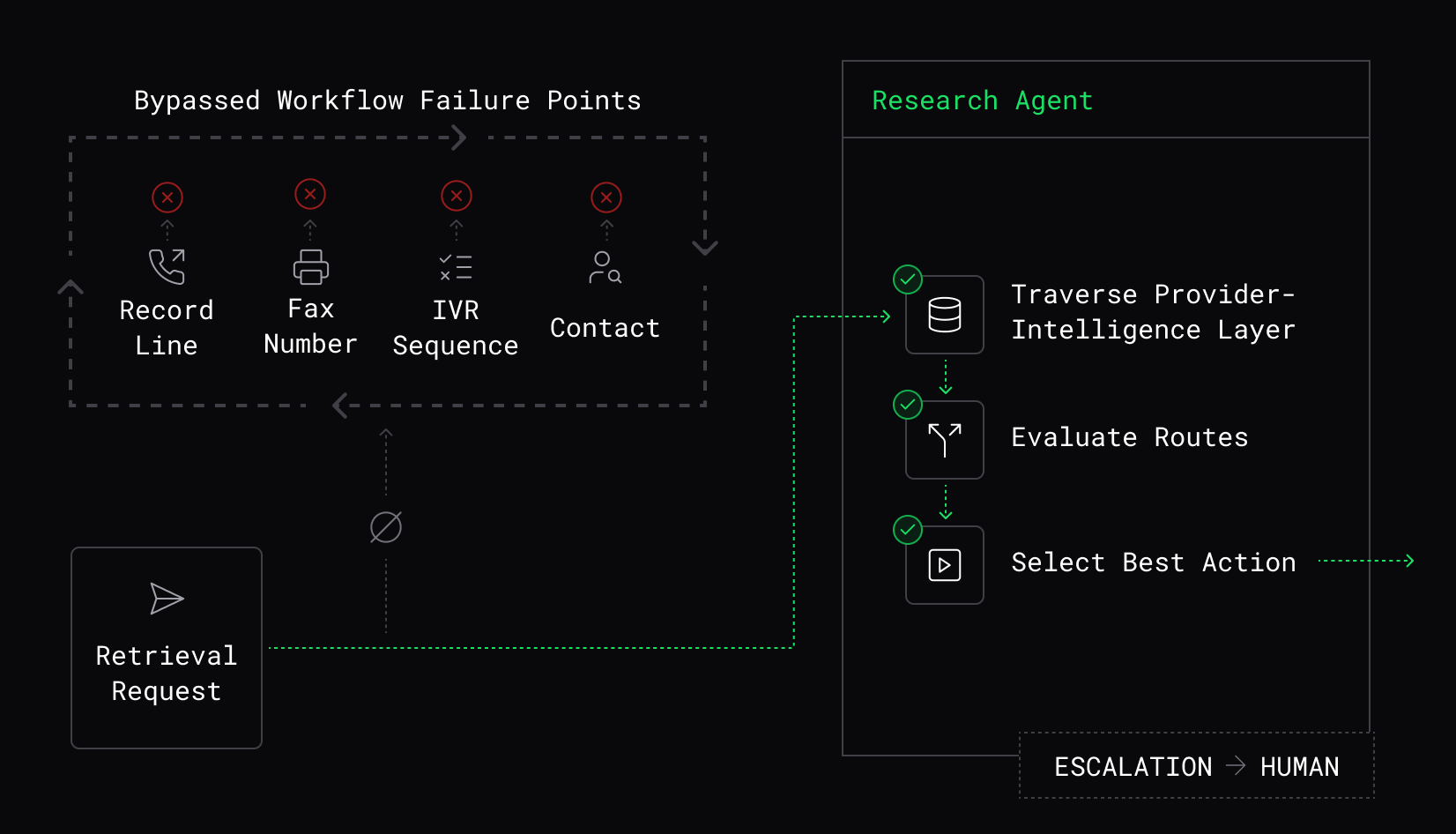
That action may be to:
That makes the handoff executable. The output is therefore not another directory result. It is an executable retrieval plan and, where needed, a structured handoff to the next agent in the system.
Exceptions expand the dataset. When an escalation occurs, and a human finds a corrected number, a new stat pathway, an unusual facility requirement, or a better contact, that resolution can be incorporated into the retrieval knowledge base. The next request begins with more operational context than the last.
The results show the value of the approach. Predoc has reduced the time required to determine and prepare the retrieval path by 70% and improved first-pass retrieval success by nearly 50%. The Research Agent also identifies requests that do not require a phone call: Predoc now completes nearly 20% of retrievals through successful cold fax, with median turnaround of less than one business day.
The gains compound. Faster research reduces the direct work required before outreach. A better first decision avoids wrong calls, transfers, failed faxes, and repeated research. And the structured handoff ensures that the Voice AI Agent begins with the highest-confidence route and the context required to act on it.
This is what distinguishes the Research Agent from any existing provider directory. It does not merely surface information. It decides what should happen next, executes when it can, and gives the next capability enough context to continue the work.
Learn how Predoc finds the right route and returns complete records.
When cold fax is not sufficient, the workflow moves into a live interaction with the provider. Predoc’s voice AI agent combines a real-time foundation model with a proprietary harness built specifically for the variability of medical-record outreach.
When fax alone is insufficient, the workflow moves into a live interaction with the provider.
This has traditionally been a one-to-one process. One operator places one call, navigates the IVR, reaches the appropriate office, confirms patient information, explains the request, captures the facility’s requirements, and documents what should happen next.
The long tail is what makes the workflow difficult. An unfamiliar facility may require several transfers, confirmation that the patient was seen there, a referring provider, a facility-specific authorization process, or information the requester did not know would be required before the call began.
The Voice AI Agent was built from the workflow’s variability. Its proprietary harness was developed and tuned using nearly 3 years of transcribed retrieval calls. Those calls exposed the possible conversational turns, required inputs, facility-specific rules, completion criteria, failure conditions, and escalation triggers found in real provider outreach.
A foundation model provides the general conversational capability. The harness supplies the job. In this context, the harness is the workflow-specific layer of instructions, context, software, structured outputs, monitoring, and escalation controls surrounding the model. It defines what information the agent must provide, what the call must obtain, what constitutes a successful or useful partial result, and when the interaction should continue, stop, retry, or move to a human.
Without that dataset, a voice model would not reliably know what the call needed to accomplish and how to accomplish it.
The bounded job is not “talk to the provider.” It is to complete a defined retrieval interaction. That may mean confirming that a records line is active, identifying the correct fax number, determining the authorization requirements, initiating a request, or collecting enough information to trigger the next action.
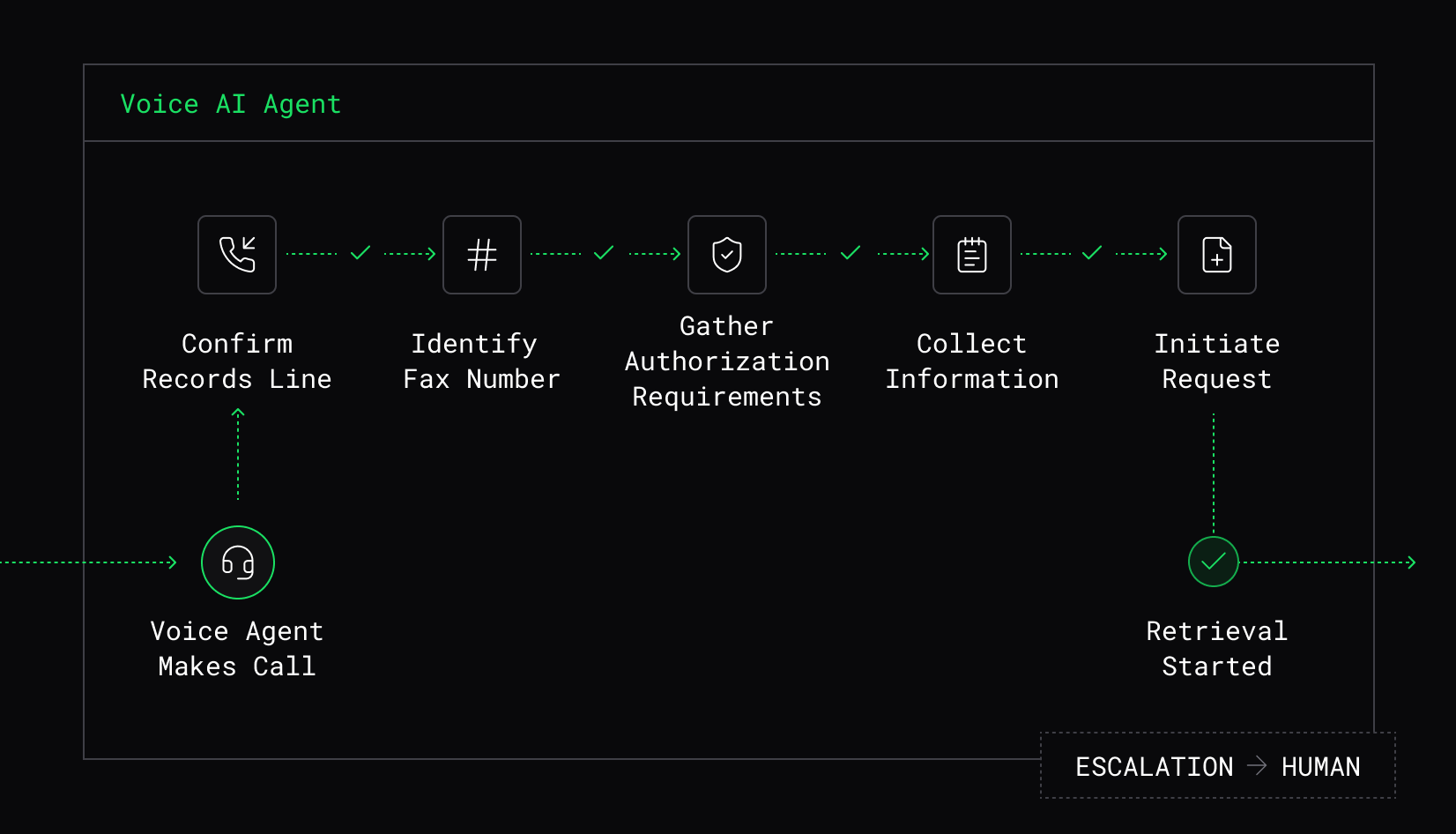
The call ends with a structured handoff. The interaction is transcribed and converted into data the rest of the workflow can act on:
Human escalation is part of the design. When the agent lacks required context, encounters an unexpected conversational turn, or detects a non-routine exception, the call can move to a person with the transcript and information already collected. The human does not have to restart the interaction from the beginning.
That resolution then improves the workflow. A newly discovered provider requirement, corrected number, unusual IVR path, or better response can become part of the instructions used on future calls.
Predoc estimates that the Voice AI Agent can reduce per-minute outreach costs by 75%–92% across common staffing models. The larger advantage is elasticity: calls can begin when requests are ready and run in parallel instead of accumulating in a backlog limited by the number of available human callers.
The model makes conversation possible. The proprietary data and harness turn that conversation into completed medical-record work.
Explore the full record-retrieval workflow, from research through delivery.
Retrieval is not complete when the records arrive. Returned records frequently come back as long, inconsistent fax or PDF packets containing multiple document types. They must be matched to the correct patient and request, separated into logical documents, classified, and filed into the appropriate sections of the patient chart.
In a legacy workflow, an indexer selects the packet from a queue and performs that work page by page. Manual indexation has historically required approximately two minutes per page. A 100-page packet can therefore consume more than three hours of active labor, before accounting for the time it spends waiting in a queue, moving between teams, or sitting untouched outside operating hours.
Predoc’s Indexation Agent begins processing when the records arrive. It associates the return with the patient and request, identifies document boundaries, classifies the contents, applies the required metadata, and determines which pages can proceed automatically.
The workflow dataset consists of millions of returned pages and the clinical reviewer decisions attached to them. Those examples show:
The Indexation Agent has a bounded job: associate the return with the correct patient and request, splice it into logical documents, classify the contents, apply indexing metadata, and determine which pages can proceed automatically.
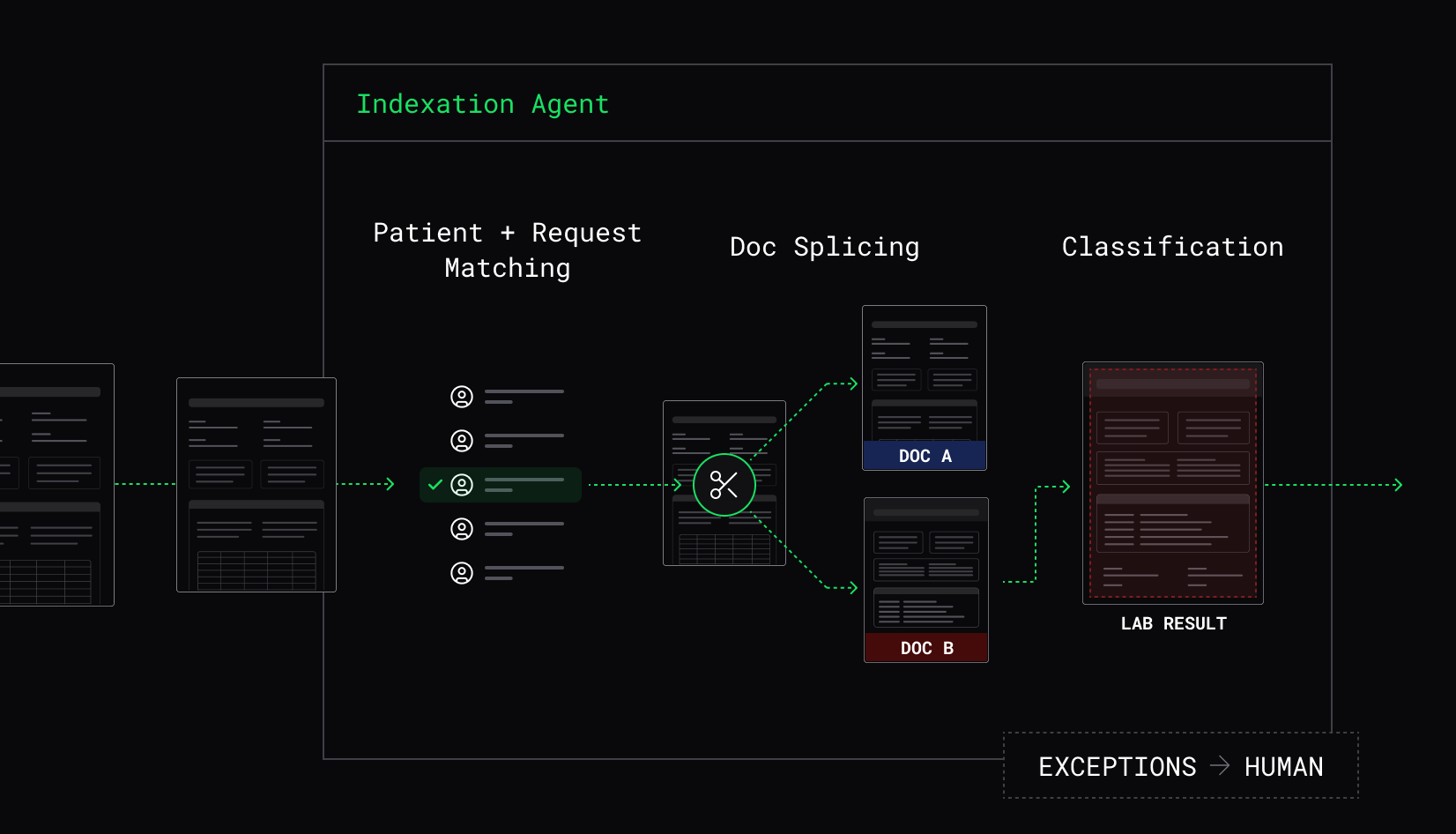
Its output is immediately usable by the next capability. The Extraction Agent does not receive an anonymous 300-page fax packet. It receives patient-matched, segmented, classified documents with the relevant source and indexing context preserved.
Exceptions define the human-review queue. Incomplete, atypical, or lower-confidence pages are routed to a reviewer rather than being forced through automation. The correction or validation becomes additional evidence about how that document pattern should be handled in the future.
Predoc has reduced the active time spent on indexation by nearly 50%. That is a deliberately narrow measure: it captures the hands-on work required to index the packet, but not the additional time eliminated when the packet no longer waits for an indexer to select it from a queue.
At the time of publication, 94.6% of medical-record pages received from providers are indexed without human intervention. People no longer need to inspect every routine page to find the minority that requires judgment. They work directly on the exceptions, allowing the same review capacity to support greater record volume without lowering the standard applied to uncertain content.
The operating model changes from requiring a person to inspect every page to directing people toward the minority of pages where judgment can change the result. The output is a patient-matched, segmented, and indexed record set ready for clinical extraction.
See how Predoc retrieves, organizes, and delivers complete medical records.
Predoc’s extraction layer converts document content into patient-level facts: medications, diagnoses, procedures, laboratory results, encounters, vital signs, allergies, and other relevant information. It also captures the dates, values, statuses, and source references required to interpret those facts correctly.
The extraction dataset is organized around the information that real medical records contain. Predoc processes each indexed record page by page and item by item, classifying the content into approximately 16 clinical categories and 10 non-clinical categories. Each category has its own schema defining the fields required downstream.
For a laboratory result, that schema may include the test name, value, unit, date, associated observation, patient, and source. For a clinical note, it may preserve the free text while identifying the note type, author or facility where available, and the relevant clinical information contained within it.
The bounded job is to convert document content into contextualized clinical objects. This is not conventional OCR. OCR can reproduce the words on a page. Predoc identifies which medical objects are present and extracts the attributes needed to interpret them.
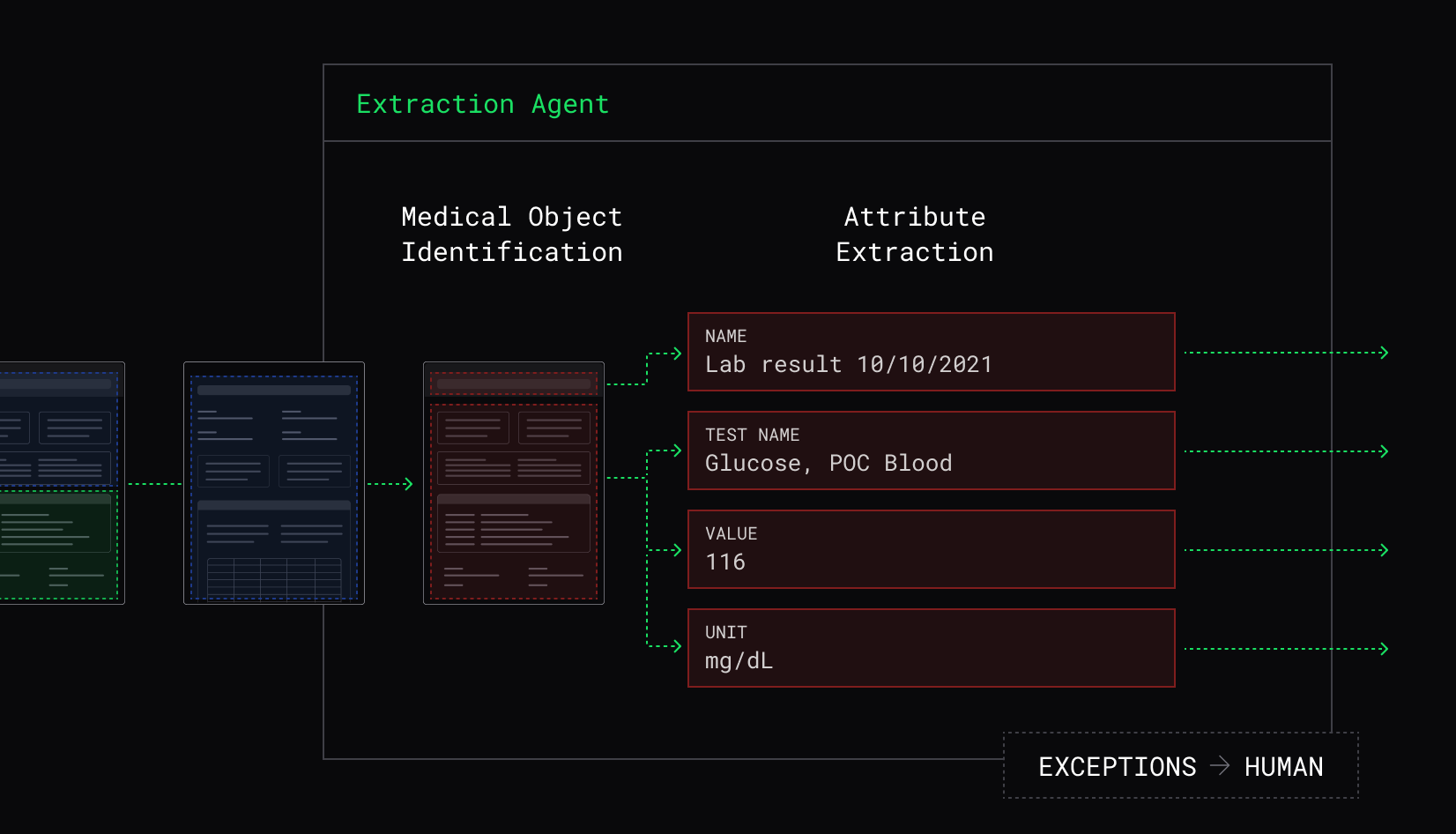
The handoff is structured patient-level data. Instead of passing a transcription of the PDF forward, the Extraction Agent produces clinical objects that can be normalized and queried together across admission summaries, laboratory reports, consultations, referral notes, and other record types.
The distinction also changes the economics of downstream use. Without structured extraction, every downstream model must search the original pages, rediscover their structure, and interpret the same facts again. That creates recurring token costs and repeated opportunities to miss relevant information. A diagnosis may appear in one document and its resolution in another; unless both are represented together as patient-level facts, a downstream application may surface only part of the clinical story.
Each category has its own extraction schema. The system looks for the specific fields required to represent that type of clinical object downstream. The output is structured, patient-level data rather than an undifferentiated transcription of the PDF.
Ambiguity is treated as an exception, not an invitation to invent context. When the record does not contain a required attribute or the clinical meaning cannot be resolved confidently, that gap can remain explicit or move to review. The resolution can then inform the extraction schema or validation logic used on similar records.
This category-by-category work has also exposed gaps between what common exchange standards transmit and what downstream clinical use requires. A problem code and date, for example, may show that a condition appeared somewhere in the record. Without sufficient status and category detail, a downstream application may still struggle to determine whether it is active, resolved, encounter-specific, or part of the longitudinal problem list.
Predoc’s extraction schemas are designed around the information required for clinical use, not merely the minimum fields needed to transmit a record. The resulting patient-level facts are then passed into the Curated Data Layer.
See how Predoc creates structured, source-traceable clinical information.
Extraction pulls relevant facts from a page, normalization determines what the information means. Predoc converts repeated, incomplete, and semantically inconsistent records into a smaller set of usable patient-level facts while preserving the context needed to trace them back to the source.
Extraction identifies the facts. Curation determines what those facts mean together.
Raw clinical data reflects the systems and institutions that produced it, not a consistent view of the patient. The same medication, diagnosis, procedure, encounter, or laboratory result may appear repeatedly, use different terminology, carry different units, or lack the context required to support a reliable clinical interpretation.
The problem is not limited to faxed records. HIE data can arrive through standardized documents or machine-readable objects and still contain duplicates, empty entries, local naming conventions, inconsistent units, and multiple representations of the same event. Exchange standards make transmission possible. They do not automatically make the result trendable, queryable, or clinically coherent.
The workflow data at this layer is the accumulated difference between raw and usable clinical information. Predoc has developed its curation methods against large-scale patient datasets that expose:
The bounded job is health-native data curation. Predoc applies normalization, semantic mapping, deduplication, and removal of non-informative records to convert those inputs into a longitudinal patient representation. A raw object becomes a curated clinical fact when it can reliably answer: what happened, to whom, when, with what value or status, under which code or unit where available, and from which source?
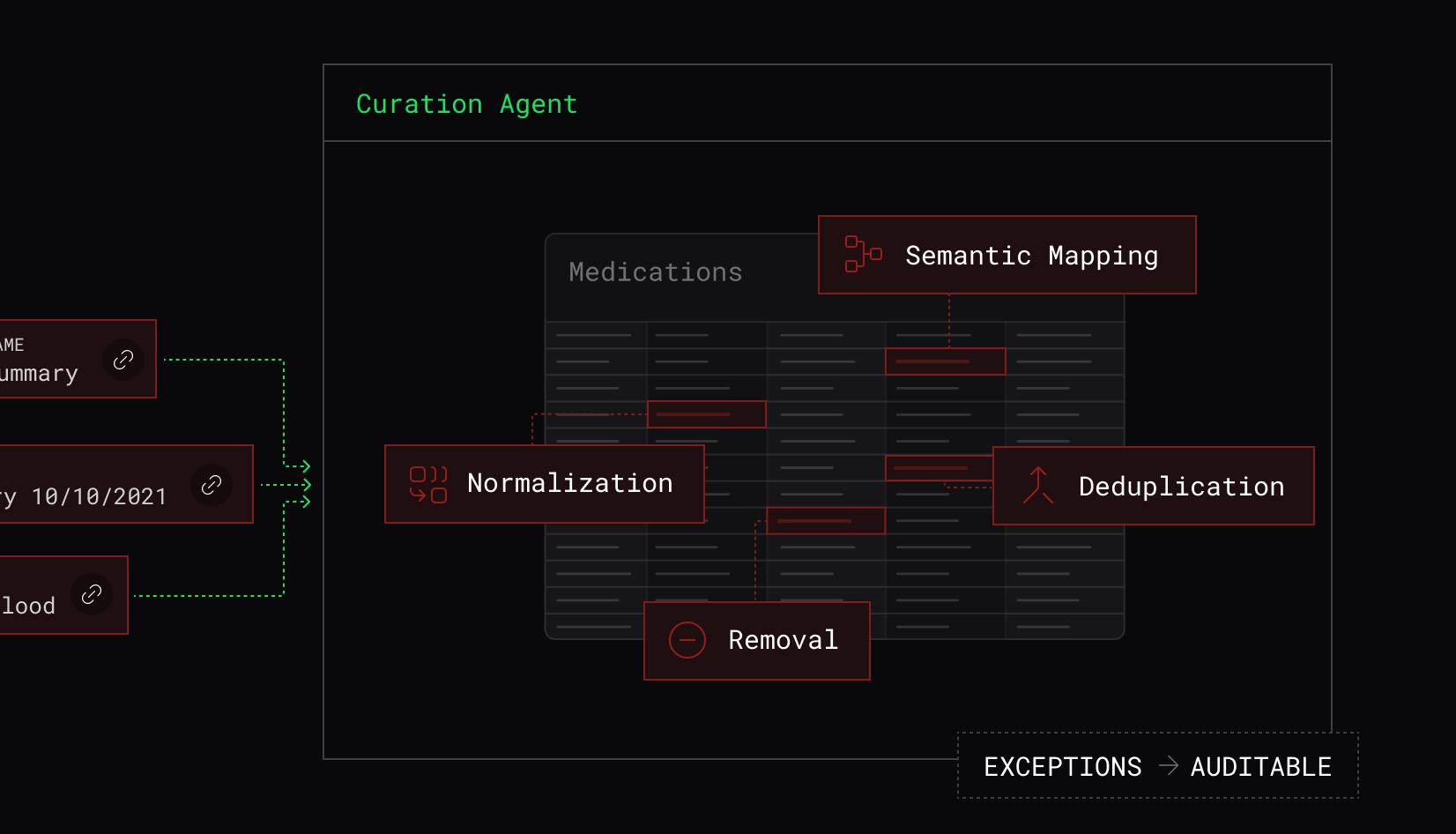
A separate analysis of 8,352 patients, limited to HIE data, illustrates the extent of that transformation. Predoc processed 60,654,992 raw rows into 25,437,669 curated rows, representing 41.9% retention across all reported categories. Within core clinical categories—including laboratory results, problems, medications, procedures, encounters, and vital signs—34,746,057 raw rows became 11,780,274 curated rows, or 33.9% retention.
The handoff is a clinical intelligence foundation: normalized, deduplicated, source-traceable patient data that can support clinical summaries, targeted questions, analytics, coding workflows, and AI applications without requiring each use case to reread and reconcile the original record packet.
Exceptions remain auditable. When facts conflict or cannot be mapped confidently, preserving source lineage allows the ambiguity to be reviewed without losing the original clinical context. The resulting resolution can improve mappings and transformation rules used on future data.
The reduction does not mean that two-thirds of the patient history was discarded. It means repeated, empty, incomplete, and semantically equivalent objects did not survive as separate clinical facts. Provenance-oriented categories were retained at 100%, preserving traceability while redundant clinical data was collapsed.
This is where the value of the earlier handoffs compounds. Research determines how to obtain the record. Voice AI moves the request forward. Indexation organizes the return. Extraction turns pages into facts. Curation makes those facts usable together.
Explore how normalized, source-traceable patient data becomes usable across clinical and AI applications.
The takeaway
Predoc has not built five unrelated AI features.
The Research Agent uses accumulated retrieval history to select and execute the best available path. The Voice AI Agent conducts the interaction and returns a structured outcome. The Indexation Agent associates and organizes the returned records. The Extraction Agent converts document content into patient-level clinical objects. The Curated Data Layer reconciles those objects into a longitudinal clinical intelligence foundation.
Each part of the system completes a bounded job, structures the result, and gives the rest of the workflow the context needed to act.
A human escalation layer spans the system. People intervene where missing context, provider-specific complexity, unusual documents, or clinical ambiguity makes their judgment valuable. Routine work moves forward automatically; exceptions arrive with the information already collected.
The underlying models can change. The operational knowledge beneath them: provider pathways, call transcripts, failed attempts, successful outcomes, document examples, extraction schemas, and review decisions, compounds each time the workflow runs.
That is the broader lesson for healthcare organizations building multi-agent systems:
Start with workflow data. Bound the job. Make the handoff executable. Learn from the exception.
The model is necessary, but it is not sufficient. The strongest workflow replacements will come from organizations that have spent enough time inside the work to capture its variability, translate tribal knowledge into structured data, and define exactly what a completed result should look like.
For Predoc customers, the result is already measurable. A process that previously took two weeks or longer now returns retrieved, indexed, and curated patient data in three business days. Capacity can expand without proportional staffing growth, and human attention remains focused on the cases where judgment improves the outcome.
Complete medical records are no longer a bottleneck to patient care. Predoc has removed the operational drag of hours spent on hold, tracking down fax numbers, processing returned documents, and manually reconstructing patient histories. Records from digital and offline sources are organized as they arrive, extracted into patient-level facts, and transformed into an accurate, normalized, source-traceable clinical intelligence foundation.
That foundation makes longitudinal patient data usable by clinicians, care teams, analytics platforms, and AI applications. Instead of asking every person or model to reinterpret hundreds of fragmented PDFs, organizations can use a coherent view of the patient to answer clinical questions, identify relevant history, support faster decisions, and deliver more personalized care.
The result is more than faster medical-record retrieval. It is an infrastructure layer that allows healthcare organizations, and the AI systems they deploy, operate on more complete, clinically meaningful patient data at scale.
Stop manually chasing and cleaning records. See how Predoc seamlessly integrates with your existing systems to deliver normalized, actionable data right when you need it.
TRUSTED BY