Blog
Becker's Healthcare Webinar

Every business has access to leading AI models, and every few months those models get cheaper and more capable. For AI-native businesses, the model is not the differentiator; the proprietary business logic that powers it is.

Every business has access to leading AI models, and every few months those models become cheaper and more capable. As access to AI becomes increasingly commoditized, I've realized something. For AI-native services businesses, the model isn't the differentiator; the proprietary business logic that powers it is.
For years, Predoc has operated with intention in one of the healthcare industry's most tedious workflows—medical record retrieval—and the goal has always been to understand that workflow deeply enough to automate it. Every FBI-level search for a difficult-to-locate specialty provider, every minute spent navigating a lengthy phone tree, every fax that was sent (and then resent), and every successful retrieval generated knowledge that no search engine or public dataset could provide. Individually, those moments seem insignificant. Collectively, they've become proprietary business intelligence.
This is our competitive advantage. At Predoc, we're transforming years of hard-earned operational knowledge into the data infrastructure that powers our system of agents.
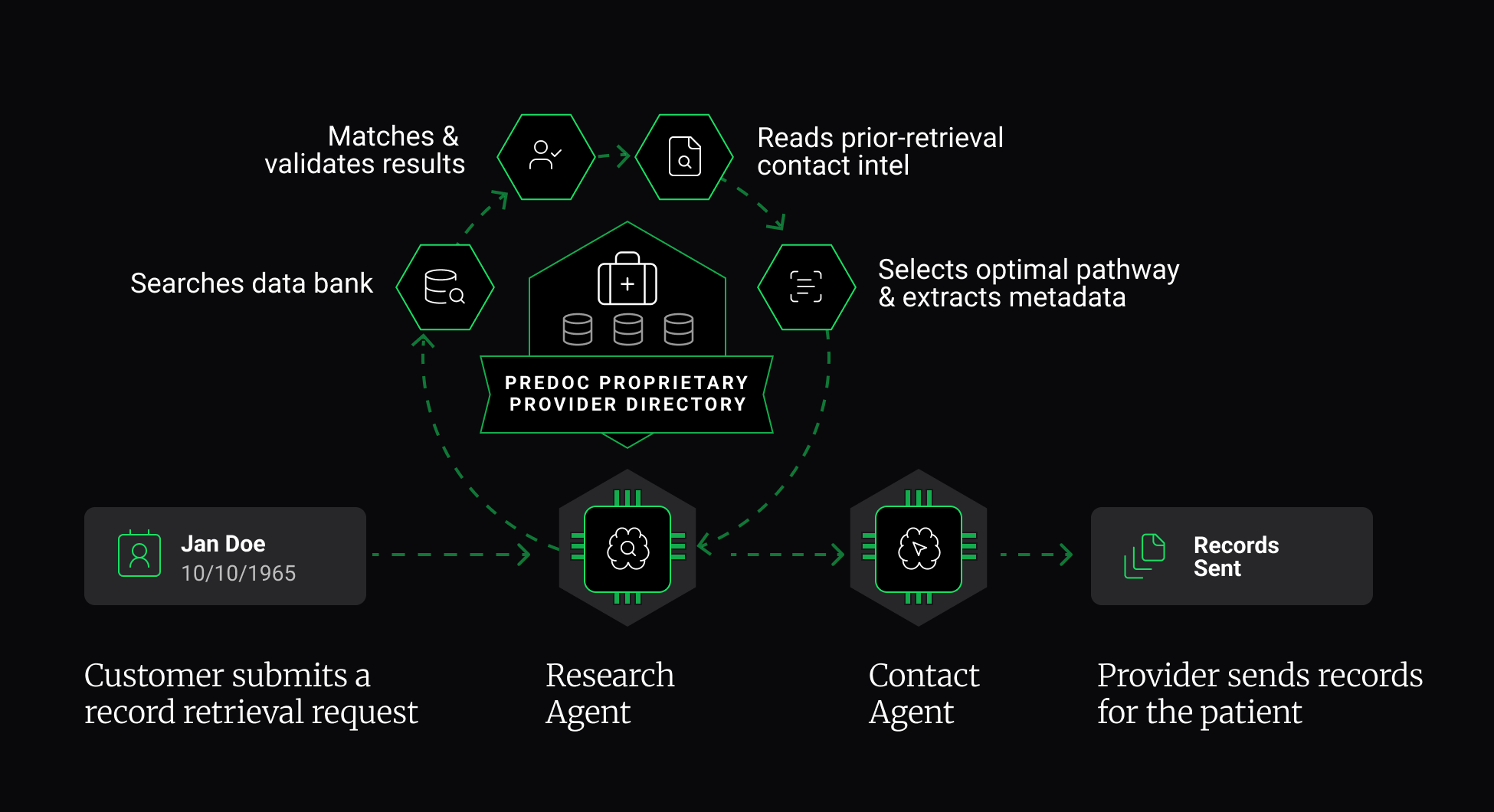
We’ve already made material gains, starting at the very beginning of our workflow - research. The Predoc proprietary provider directory transforms years of operational knowledge into structured data, capturing the intelligence required to identify the right provider and contact method. It’s offline proprietary intelligence that can’t be purchased or found in any public dataset, and it’s only the first building block.
Every business accumulates knowledge that never makes it into a database. I've seen it across every healthcare company I've worked with:
Most organizations leave this data trapped in Slack messages, free-text comments in a CRM tool, spreadsheets, sticky notes left on computers, and most often, actually, in individual memory. But it’s the activation of this operational intelligence, which can’t be bought or scraped, that differentiates legacy services businesses from top tier AI-native services businesses.
Every month, our team processes tens of thousands of medical record requests to retrieve information beyond digitally connected networks. Every request is unique and teaches us something about our process:
Most companies experience those lessons and move on to the next request. We intentionally captured them so AI could put that knowledge to work. The next question became: where do we start?
The provider directory addresses the first step of every medical record retrieval workflow: knowing who to contact and how to contact them.
It was the natural place to begin because every downstream step depends on getting it right. Before a single phone call is made or a fax is sent, someone has to answer one question that you would think is simple: who do we contact to request these records?
Across the thousands of record requests we process each week, many arrive with incomplete information. Unsurprisingly, patients rarely remember everything about their care team. Sometimes they know a physician’s last name but not their first name. Sometimes they remember a health system but not the practice. Sometimes they forget the specialty of their physician.
At first glance, this sounds like a search problem, but it’s an operational one. Predoc started with the same public resources everyone else does - the NPI registry, practice websites, and Google. We even layered in third party tools for access to datasets that weren’t available publicly. While those tools are helpful for identifying the right provider, they stop there. They don't tell you where the records actually live, how an organization processes requests, or the fastest path to retrieving them.
Years of executing medical record retrieval workflows taught us that provider research extends far beyond identifying the right physician, and we’ve documented our learnings along the way. This proprietary intelligence tells us:
Our AI team extracted those fragmented learnings from tens of thousands of notes so that we could take this knowledge and turn it into infrastructure. Years of free text comments and documented call outcomes were translated to structured and validated data that now powers a provider directory purpose-built for medical record retrieval.
The result isn't just a better search experience; it’s an AI-enabled workflow. One that can take minimal information, surface the right provider, recommend the fastest path to retrieving records, and preserve years of operational expertise to make the manual process much faster.
What this translates to is incredible. Research that once took ten minutes now takes seconds. But the bigger impact isn't speed; it's consistency. Every retrieval now starts with the benefit of years of institutional knowledge, leading to more accurate outreach, faster retrievals, and a stronger foundation for the AI workflows we're building next.
Our provider directory accelerates retrievals, helping our customers get records faster. The much bigger opportunity is what comes next.
The data we've captured isn't just for human task automation. It's the foundation AI agents will use to complete medical record retrieval tasks autonomously. Instead of automating provider research, voice calling, authorization form routing, etc, as disconnected steps, AI agents will orchestrate the entire workflow, moving intelligently from one stage to the next.
Even more importantly, our data foundation continues to grow. Just as we’ve learned from the past few years, every successful retrieval, failed outreach attempt, rejected authorization, and operational exception will continue to teach us something new. But now, these data points will feed back into our systems for greater intelligence and outcomes.
Every workflow we automate creates better data. Better data enables more capable AI agents. More capable AI agents automate more of the workflow, generating even richer proprietary workflow intelligence that compounds into a durable advantage.
Models will continue to improve for everyone, but our workflow intelligence will improve every time we do the work.
Stop manually chasing and cleaning records. See how Predoc seamlessly integrates with your existing systems to deliver normalized, actionable data right when you need it.
.png)